Every project management tool sold in 2026 wants to talk to you about predictive analytics.
Feed it your historical data, the pitch goes, and it will forecast your delivery date, flag your risks before they materialize, and tell you how your budget will land - all before the project even gets properly underway. It's a genuinely useful capability. It's also being sold with far more confidence than the underlying math deserves.
This post is about the honest version of that pitch: What your historical project data can actually tell you about the future, and the specific, predictable ways it stops being useful. It's the natural next step after Why "Data-Driven" Project Management Sometimes Isn't - because overselling what historical data can predict is its own form of data decoration, just dressed up in a more technical vocabulary.
What Historical Data is Genuinely Good At
Used carefully, your past projects are one of the best forecasting tools available to you, for a specific reason: They contain the errors you're actually good at making, not the errors a textbook assumes you'll make.
Estimation bias correction
If your team has historically delivered features in 1.4x the time originally estimated, that ratio is a far better predictor of your next estimate than the estimate itself.
This is the core idea behind reference class forecasting - instead of estimating a new project from first principles, you look at how a class of similar past projects actually performed and adjust from there.
Daniel Kahneman and Amos Tversky's research on the planning fallacy found exactly this pattern: People are consistently, predictably over-optimistic about their own projects, even when they're perfectly capable of being realistic about other people’s.
(Prospect Theory: https://en.wikipedia.org/wiki/Prospect_theory)
Variance, not just averages
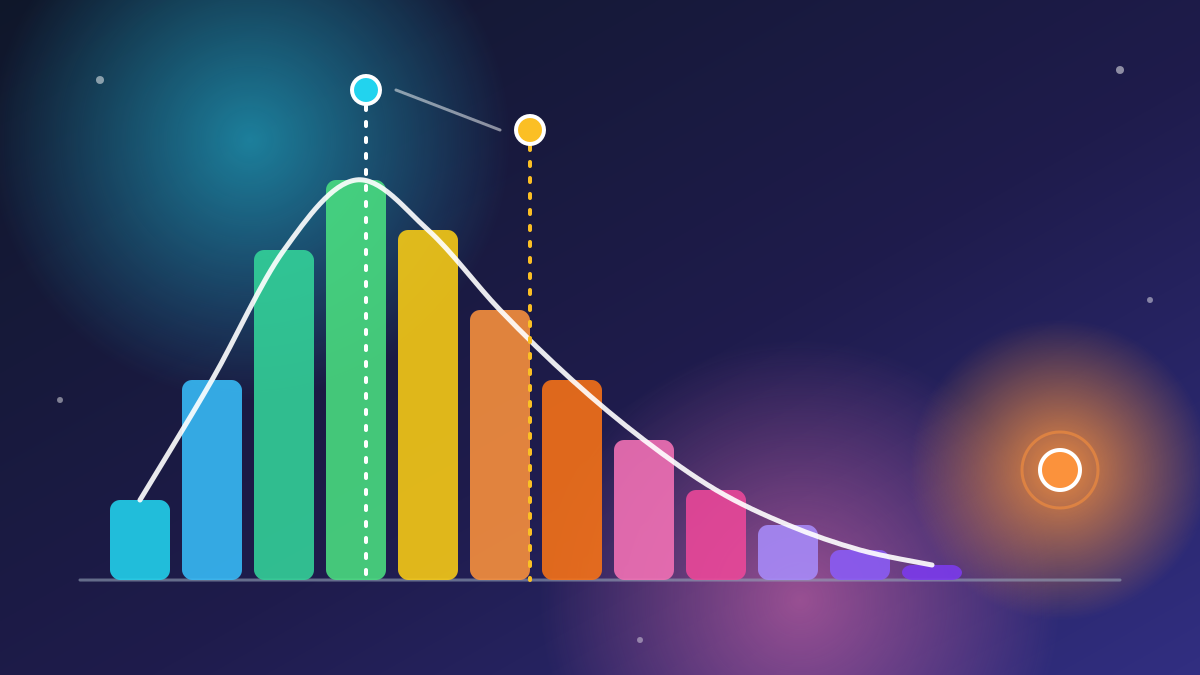
Historical data doesn't just tell you how long something usually takes - it tells you the spread. If your last ten similar projects ranged from 8 to 19 weeks, "probably around 12 weeks" is a much more honest estimate than a single confident number, and your historical data is what lets you say it.
Known risk patterns
If scope creep has shown up in 7 of your last 10 projects around the same phase, that's not a coincidence worth ignoring. Historical data is excellent at surfacing risks that are specific to how your organization actually runs projects, which generic risk checklists can't do.
Leading indicators that have actually correlated with trouble before.
If early code-review turnaround time has reliably predicted late-stage defect spikes in your past projects, that correlation is worth tracking going forward. This is the legitimate core of "predictive analytics” - using a pattern that has actually held in your own data, not a generic industry benchmark.
Where the Pattern Breaks - and Why it Breaks Predictably
Here's the part the "feed it your data" pitch tends to skip: Historical data predicts the future by assuming the future resembles the past. The moment that assumption breaks, the forecast doesn't just get less accurate - it can become actively misleading, because it still looks like a confident, data-backed number.
A New Team
Your historical velocity, cycle time, and estimation accuracy were produced by a specific group of people with specific working habits. A new team - even one doing similar work - hasn't earned the right to be forecast by someone else's historical performance. The data isn't wrong; It's measuring the wrong thing.
A New Domain
A team that's reliably accurate at estimating backend infrastructure work is not automatically reliable at estimating a customer-facing redesign. The skill that made past estimates accurate was often domain familiarity, not some general "good at estimating" trait - and that familiarity doesn't transfer.
New Constraints
A new regulatory requirement, a new client, a new technology stack, a new dependency on a team you haven't worked with before - any of these can invalidate a pattern that held reliably for years. Historical data has no way of knowing a constraint is new; it just keeps extrapolating from a past that no longer applies.
Small Sample Sizes Dressed Up as Patterns
Three past projects is not a trend, even if all three happened to go the same way. It's tempting to treat "the last two times we used this vendor, we were late" as a reliable signal, when it might just as easily be two data points of ordinary variance. The smaller the sample behind a forecast, the more confidently it tends to get presented - which is backward.
Survivorship in Your Own Dataset
If your historical "successful projects" data only includes projects that made it to completion, it quietly excludes the ones that got canceled or radically descoped along the way - which means your baseline is built from a dataset that's already missing its worst outcomes.
This is why Bent Flyvbjerg's research on megaproject forecasting - one of the most-cited bodies of work on the subject - found that cost and schedule overruns were remarkably consistent across decades and across entirely different industries, largely because forecasters kept under-weighting exactly this kind of discontinuity between past and present conditions.
What you Should Know about Megaprojects and Why: An Overview: ( https://journals.sagepub.com/doi/10.1002/pmj.21409 )
Where AI Forecasting Fits
AI-driven forecasting tools are genuinely better at one specific thing: Continuously updating a prediction as new data comes in, rather than locking in a forecast at kickoff and revisiting it only at major milestones. That's a real improvement over a static Gantt-chart forecast.
What it cannot do is know when your situation has become the exception rather than the pattern.
A model trained on your historical projects has no way of knowing that this particular project has a new team, a new client, or a new regulatory requirement, unless someone explicitly tells it so - and most of these tools don't prompt you to.
The uncomfortable industry context is worth knowing too: By most current estimates, only a small fraction of organizations are using AI substantially in project management today, which means most of the "predictive analytics" marketing is describing where the category is heading, not where most teams' actual practice currently is.
None of this is an argument against using these tools. It's an argument for treating their output the way you'd treat any forecast built on historical data - useful, directionally sound, and worth a deliberate check for the specific ways your current project might not resemble the past one.
A Practical Way to Use Historical Data Responsibly
- Start every estimate with your own historical ratio, not a fresh guess. If past estimates ran 1.3x long, apply that multiplier before you do anything more sophisticated.
- Report a range, not a number. The spread in your historical data is information - use it, rather than collapsing it into a single confident date.
- Name what's different about this project, explicitly, before you forecast. New team, new domain, new client, new constraint - write it down. If the answer is "nothing," your historical pattern is probably a reasonable guide. If the answer is "several things," discount the pattern accordingly.
- Check your sample size before you trust a pattern. Three data points pointing the same direction feels like a trend. It usually isn't one yet.
- Ask what's missing from your historical dataset. Canceled projects, de-scoped projects, and projects nobody wanted to log accurately are often the ones most informative about what can go wrong - and the ones most likely to be absent from the data you're forecasting with.
- Treat an AI-generated forecast as a starting point for a conversation, not an answer. Ask what data it was trained on, and whether that data includes a project that looked like this one.
The Conclusion
Your historical project data is one of the most valuable things you have for forecasting the future - but only for the part of the future that resembles the past.
It's very good at correcting for your own predictable biases and showing you the real shape of your uncertainty. It's not good at knowing when it no longer applies, and no amount of machine learning layered on top changes that fact - it just makes the wrong forecast look more confident while it's being wrong.
The next time you build an estimate from past data, spend as much time asking what's different this time as you spend calculating the number.
Semoga Beruntung