There's a boardroom debate happening at a lot of companies right now, and it's usually framed as high-stakes: are we bringing everyone back to the office, staying hybrid, or committing to remote? Leadership decks get built around it. Return-to-office mandates get announced and walked back.
Somewhere in the middle of it, a project manager is quietly wondering whether any of this is actually going to affect their delivery numbers.
The answer is no.
What the Data Actually Shows
Project Management Institute’s (PMI) Pulse of the Profession 2024 report measured project performance rates across three work arrangements.
The results: 73.2% for fully remote teams, 73.4% for hybrid teams, and 74.6% for in-person teams.
A one-and-a-half-point spread. That's not a meaningful gap by any reasonable statistical standard.
Reference: PMI Pulse of the Profession 2024 https://www.pmi.org/learning/thought-leadership/future-of-project-work
PMI's own framing is direct about this: remote, hybrid, and in-person teams perform at nearly identical success rates, challenging common perceptions that remote work is less effective.
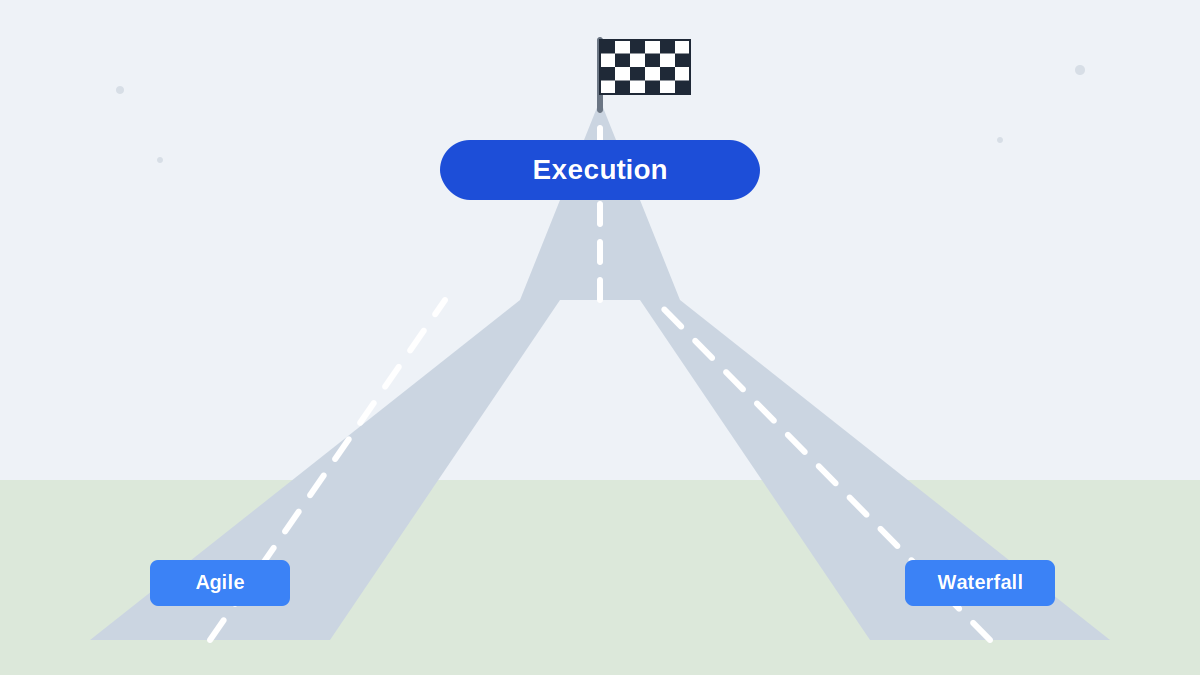
The report's broader conclusion pairs this directly with the ways of working - project teams perform equally well using predictive, hybrid, and agile approaches and within onsite, hybrid, and remote work arrangements.
Two separate variables, both once assumed to be decisive, both turning out to barely move the needle.
This lines up with something else worth sitting with: this data comes from 2024, in the middle of a very public return-to-office push across the industry, with plenty of executives publicly arguing that in-person work is necessary for real collaboration and output. The data available at the time didn't support that as a performance argument - whatever else return-to-office is about, it doesn't have a project-performance data trail behind it in this dataset.
Why this Surprises People
The intuition behind "in-person is more effective" is understandable.
Hallway conversations, whiteboard sessions, the sense that you can read a room - all real, all valuable in specific moments. But intuition about collaboration quality and actual measured project outcomes are two different things, and the data measures the second one.
There's also a selection effect worth naming: by 2023, remote and hybrid work weren't experimental anymore. Organizations had three years to build the muscle - improve communication habits, documentation discipline, structured check-ins, tooling that doesn't assume everyone's in the same room.
The performance parity in the data isn't evidence that location never mattered. It's evidence that most organizations adapted to whichever location model they landed on, and the adaptation is what mattered, not the location itself.
That reframe matters, because it points to the same conclusion as the methodology data: it's not the category you're in, it's how well you're operating inside it.
The Real Variable
PMI has a term for organizations that consistently perform well regardless of which work arrangement or methodology they're using: gymnastic enterprises.
These are organizations focused on outcomes rather than process, with a clear sense of how to balance structure and governance against the need to flex and pivot on demand. They don't win by picking the correct location policy or the correct framework - they win by building the organizational capability to perform well under whichever conditions they're operating in.
Concretely, PMI's research points to a few things that actually do move performance, regardless of where the team sits:
- Enablers like mentoring, communities of practice, and skills development. Organizations offering these saw a measurable performance increase over those that didn't.
- Structured collaboration and clear escalation paths, particularly for distributed teams - the absence of these is what actually causes the delays people mistakenly attribute to remote work itself.
- Business acumen and power skills, these transfer across every location model, while location-specific habits (hallway check-ins, desk-side updates) don't.
None of these are location policies. They are organizational habits that happen to work whether your team is down the hall or three time zones apart.
What this Means for Your Next Planning Conversation
If you're a Project Manager whose organization is currently locked in a return-to-office debate, here's the useful reframe: that debate is not your project performance lever, and treating it as one will burn energy you could spend on things that actually move the numbers.
Instead, the questions worth asking are the same ones that mattered before anyone was debating office attendance:
- Do we have structured, reliable ways to communicate status and blockers - regardless of whether that happens in a hallway or a Slack thread?
- Are we investing in the skills and enablers PMI's data ties to performance, or assuming proximity will substitute for them?
- Where are our actual delays coming from - and can we honestly trace them to work location, or are we blaming location for a documentation or escalation problem?
Just like the agile-versus-waterfall debate, the remote-versus-in-office debate has real considerations behind it - culture, mentorship for junior staff, personal preference and cost.
It's a legitimate conversation for an organization to have. It's just not a project-performance conversation, whatever the loudest voice in the return-to-office debate wants you to believe.
To Conclude
Your project's success rate doesn't know whether your team is in a shared office, scattered across time zones, or somewhere in between.
It knows whether you have real visibility into status, whether your team has the skills and support to execute well, and whether you're following through on the process you chose.
Location is a policy decision with real organizational tradeoffs. It's just not a performance lever - and the data says so plainly enough that it's worth ending the debate on those terms right now.
Bon Courage (bun koo-rahzh)